Sunday, August 10, 2008

Who is Jesus

Who is Jesus? (from a sermon given at Randburg Methodist Church just before Easter)

Those of you who know me will know of my passion for Alpha so you won’t be surprised that most of my sermon is based on Nicky Gumble’s book, “Questions of Life” .

We will be looking at Who is Jesus. What did he say about himself. If he didn’t claim to be God, then that is the end of the story, but if he did, that opens another set of questions. If Jesus said he was God, Was he right? If he was wrong, either he knew he was not God and deliberately set about trying to fool people, or he really believed he was God but was mistaken, in other words He was mad.. We will look at evidence so you can decide for yourselves. Some people don’t need evidence. They believe what their parents or Sunday School teachers told them.

But I am a scientist. My father told me “A good scientist takes nothing for granted, but tests everything.” I first put this into practice when I was very young. My parents told me there were such things as germs which you couldn’t see but could make you sick and you had to wash your hands before eating and after stroking the cat. Now who is going to believe in something you can’t see just because your parents say so? I knew it was just a ploy to have children with clean hands to impress their friends. Later on I went to University and studied Microbiology. Now I believe in germs – I can even classify them.

Then there was the whole World is round thing. Anybody can see the world is flat, apart from a couple of hills and valleys of course. It was only when I first flew in an aeroplane that I could see for myself that the world is actually round.

Perhaps you re a bit like me and you want to find out for yourself without believing everything you are told. In this talk I am going to use a number of quotations from the bible. Don’t just take my word for it, look them up yourself.

So, Who is Jesus. Did he really exist? Besides the new testament, there are accounts about him from other historians.. eg the Roman historian, Tacitus, Suctonius and the Jewish historian, Josephus, born in AD37.

He wrote the following:

“Now there was about this time, Jesus, a wise man, if it be lawful to call him a man, for he was a doer of wonderful works – a teacher of such men as receive the truth with pleasure. He drew over to him both many of the Jews and many of the Gentiles. He was Christ and when Pilate, at the suggestion of the principal men among us, had condemned him to the cross, those that loved him at first did not forsake him, for he appeared to them alive again, as the divine prophets had foretold these and ten thousand other wonderful things concerning him: and the tribe of Christians, so named after him, are not extinct to this day.

Although there is evidence outside the New Testament for the existence of Jesus, most of our information does come from the New Testament. People might say, O but how do we know that what has come down to us s what people wrote so long ago? We do know because of a science called textual criticism. Essentially, the more texts we have, the less doubt there is about the original. F J A Horst, a leading textual critic has said, “In the variety and fullness of the evidence on which it rests, the text of the new testament stands absolutely and unapproachably alone among ancient prose writings”

So, if we accept that Jesus existed, Who is he? Was he just a good man, a great religious teacher, or was he and is he, God?

First of all, let’s look at what Jesus said about Himself.

In the Old Testament, Moses asked God what his name was. God said, “I am who I am. Tell them, “I am” has sent you.” The word, Yaweh, meaning “I am,” is very similar to the word used to translate, the Lord, in the Old Testament. The Jews did not take the name of God on their lips.

What did Jesus say? “I am the bread of life” (John 6:35.) Psychologists recognize that there is a deep hunger in the human heart. Freud said, “People are hungry for love” Jung said, “People are hungry for security”, Adler said, “People are hungry for significance” and Jesus said, “I am the bread of life.” In other words, if you want your hunger satisfied, come to me. He also said, “I am the light of the world” and “I am the resurrection and the life” This is not the sort of thing great religious leaders say. Great religious leaders might say, “I will show you the way,” Jesus says, “I am the way”. Great religious leaders might say, “I will tell you the truth,” Jesus says, “I am the Truth”, Great religious teachers might say, “I will teach you how to live the life”, Jesus said, “I am the Life.” So in a culture where people did not use the name Yaweh, or I am, Jesus was I amming all over the show.

He said that to receive him was to receive God and to have seen him was to have seen the Father.

Then there are his indirect claims. He claimed to forgive sin.

In Mark 2 vs 5 he said to the paralytic, “Son, your sins are forgiven.” Some teachers of the law were sitting there and thinking to themselves, “Why does this fellow talk like that? He’s blaspheming! Who can forgive sins but God alone? Jesus knew what they were thinking and he said, “Which is easier, to say to the paralytic, ‘Your sins are forgiven,” or to say, Get up, take your mat and walk’? But that you might know that the son of Man has authority on earth to forgive sins….” He said to the paralytic, “I tell you, get up, take your mat and go home.”

Jesus also claimed that one day he would judge the world. Now imagine if your minister stood up in the pulpit one day and said “On the day of judgment you will all appear before me and I will decide your eternal destiny on how you treated me and my friends” I think we would start questioning his sanity and possibly make an appointment with a panel of psychologists at Tara.

Then there are his direct claims: In Mark 14:55-64 we read the account of Jesus standing before the high priest. They were having difficulty convicting Jesus. They had even hired a couple of false witnesses to tell lies so they could get something on him. Unfortunately the witness’s testimony didn’t agree. The high priest was getting very frustrated. Jesus wouldn’t answer questions! He was being accused mostly of blasphemy from the Jewish point of view and of inciting riots from the Roman point of view. The chief priest asked him directly, “Are you the Christ, the son of the blessed one?

What did Jesus say? I AM.

On the other end of the social scale we have the Samaritan woman. She’s been having a conversation with Jesus and it had got onto spiritual things. She talked about the promised Messiah. Jesus said, “I who speak to you am he.”

. Now, just because somebody says they are something, it doesn’t make it so. Lots of people say lots of things and they are not always true. Some of you might remember Paul, who used to hang around the church. He once told me he was an angel from God sent on a secret mission. There are people in insane asylums who claim all sorts of things. Politicians claim many things but that doesn’t make them true. We need to look at the evidence and decide whether Jesus was telling the truth

Let’s look at the evidence. What did other people say about Jesus? What did Peter say about Jesus? Jesus once asked him. He said, “Who do people say I am?” Peter had all sorts of ideas, “some say you are John the Baptist, some say this, some say that.” Then Jesus asked him, “Who do you say that I am?” Peter said, “You are the Christ, the son of the living God.” ((Math 16:16) Peter had been with Jesus. He had had time to examine the evidence. He had seen how he lived.

Then there was the centurion. He had seen how Jesus died. He said, “surely this man was the son of God.”

His teaching: His teaching is widely acknowledged to be the greatest teaching that has ever fallen from human lips. His teaching is the foundation of Western civilization, many laws were originally based on it. Institutions like the Red Cross, Hospitals were based on Jesus teaching. We are making great progress in fields of science and technology, communication and travel and yet in 2000 years no one has improved on the moral teaching of Jesus Christ. Could that teaching really have come from a con man or a mad man?

His works. Jesus said that the miracles he performed were evidence that “the father is in me and I am in the father “(John 10:38)

Jesus was most amazing person to have been around. At a Party, out sailing, at a picnic, hospital visiting.

But mostly it was his love that stood out. Love for those rejected by others, prostitutes, lepers, people who were not in the “In crowd.”

Are these the actions of an evil or deluded man?

His character. Here was someone who was unselfish, humble, but not weak, full of joy but never at another’s expense. Even his enemies could find nothing to accuse him with except that he claimed to be God. The greatest test of character is how you react under pressure. How did Jesus react when he had been tortured, was in pain on the cross? He said “Father, forgive them?” ((Luke 22:34) Was a man with a character like that evil, or unbalanced?

His fulfillment of Old Testament prophesy. Jesus fulfilled over 300 prophesies spoken by different voices over 500 years. Of course some say he could have studied all the prophesies relating to the Messiah and gone around fulfilling them. But some were quite difficult. Eg where he was to be born or about his death and even burial.

His resurrection.

What evidence do we have that Jesus rose.

His absence from the tomb. Many people have come up with a number of different theories about how this happened. Some say Jesus wasn’t really dead.

Well for a man who had undergone a Roman flogging, under which many died, been nailed to a cross for 6 hours, it seems very unlikely that he would have been strong enough to move a stone weighing about 1500 kg. The soldiers were convinced he was dead and they were experts. This was their job. Moreover, one of the soldiers pierced Jesus’ side with a spear (John 19:34) and blood and water gushed out. This appears to be the separation of clot and serum which we know today is strong medical evidence for death, but which they wouldn’t have known in those days.

Some say the disciples stole the body. This is psychologically improbable. They were defeated and downcast , depressed and disillusioned. It would have taken more than a seedy plot to transform them into dynamic evangelists. They suffered floggings, torture and death. Nobody dies for a lie.

Some say the authorities stole the body. Well then, all they had to do, when the rumours started that Jesus was alive was to produce the body. They never did.

The other interesting thing is John’s account of what he saw when the women told him the tomb was empty. In fact it wasn’t empty. The grave clothes were there.

If I was going to steal a dead body, I would take it wrapped and all.

His appearances to the disciples.

Jesus appeared to his disciples on 11 different occasions over 6 weeks. Over 500 people saw the risen Jesus. He was not a ghost. He could be touched and ate broiled fish. On one occasion he cooked breakfast for the disciples. While one person could have an hallucination, 500 is a bit much. And hallucinations don’t cook breakfast.

The immediate effect.

Jesus rising from the dead had a great impact on the world. Christianity spread at a tremendous rate.

Christian Experience. Christians all over the world are experiencing a relationship with Jesus Christ. There are many in this room who will testify to his reality. Many of us spoke to Him just half an hour ago.

I said at the beginning I want you to think for yourself, make decisions for yourself. Examine the evidence for yourself. Jesus said he was God. Was he lying? Was he a mad man… or was he telling the truth.? One thing is for sure. He was not a good man or a great human teacher.

C.S. Lewis said, “A man who was just a man and said the sort of things that Jesus said wouldn’t be a great moral teacher, he’d either be a lunatic – on a level with a man who says he’s a poached egg – or else he’d be the devil of hell. You must make your choice…”

If you have a bit of scientist in you, I encourage you to do some experiments. You could, for instance pray. Ask Jesus to show you if he is alive. Another approach you could take is to assume he is God, and act as if that was true and see whether refuting evidence comes along. If you prefer the intellectual approach, do some research, read through the gospels critically as history and try to get a picture of Jesus The Gospel of John is a good place to start.

.

Thursday, August 7, 2008

Every silver lining has a cloud

image

I first started thinking about it when someone asked me how my weekend was.   I said it was great.   But looking back, there were moments when I was in tears.   There were moments when I missed my husband who was not with me.   Overall, however, it was a great weekend.

As I considered memorable events and occasions, I realised that most of them contained an element of sadness or stress or even pain.

The days when my children were born were some of the high points of my life.   Yet without doubt there were moments of pain, fear, exhaustion and even irritability.   Yet over all - absolutely awesome and momentous.

When I took a group of Girl Guides to an international camp in Canada, it started badly.   Canadian Guiders had kindly agreed to share tents with us.   My assistant and I were separated from each other and from our girls who were put under the care of Canadian Guiders.   There were hundreds of dome tents pitched on a large field for the adults.   The lady I was sharing with was not there when I arrived so I put my stuff in the tent and went off to do the things we needed to do.   At about 9.30 we were finished and it was about time to think about bed.   I couldn't find the tent where I was supposed to be.   I wandered round and round looking for landmarks.   By now it was really late and almost everybody was already tucked up in bed and sleeping.. I can't remember how I found the tent.   I only remember sitting outside the ladies toilet crying.

That was not the only stressful event of the camp.   Three people were killed on a light airplane trip and my assistant and I helped by taking charge of the Guides who had been in the care of one of them.   Later during the camp a tornado hit and we all had to be evacuated to a local church hall.   Arrangements were made with a local laundry to dry all the wet sleeping bags.

Image0002 I can think of other occasions - the training weekend where I felt I just couldn't cope with the task I was given but by the end of the weekend I had done it; the Otter Trail where I was so sick and miserable and tired that I felt like giving up but didn't.   It seems to me that the most worthwhile things reflect a true balance of life.  Life is not only about the silver linings, awesome though they may be. It is about the real stuff - the struggle, the pain, the disappointments.   If we only had silver linings we would not recognise them.   We need the clouds too.   If you are in the middle of a dark cloud remember the words of King Solomon "This too will pass..." and perhaps the following link will help you put things in perspective while you wait for the silver lining.     http://mylemonadestand.wordpress.com/2007/07/04/top-10-quotes-on-hope/

Sunday, July 27, 2008

No Guts No Glory

clip_image001

No worthwhile achievement comes without effort, without sacrifice or without courage. People and forces will try to stop you from achieving your goal. You are at war.

What is the enemy? It can be summarized as “The Flesh” but contains many different elements.

v Your heredity. The genes you have inherited from your parents have shaped a lot of your characteristics. You might be tempted to say, “I am lazy, that’s just how I was born” or “I am not a tidy person. A leopard can’t change his spots.” You might even blame your parents – “I’ve got my Dad’s bad temper”

v Your past. These are the experiences and decisions in the past that have shaped what you now are. Your early circumstances, your level in society, the advantages and disadvantages you may have had. It includes your training, the example set by your parents, their mistakes, your mistakes. You are a product of the decisions you have made. “I had a bad start in life. My Dad left us when I was little and my Mom turned to alcohol. What chance do I have?”

v Your human nature which is more commonly called “the Flesh” in the Bible. You will recognize this human nature by the following characteristics. It would rather stay in bed than get up early and pray. It would rather chuck the paper on the floor than pick it up and put it in the dustbin. It would rather be brought coffee in bed than make coffee for somebody else. It would rather eat chocolate than apply the discipline of dieting. It would rather watch TV than study. It hates being told what to do, it resists discipline and does what it feels like.

clip_image003Fortunately you do have various weapons at your disposal.

v

v

v

v

v

v

v Devine help. You are made in God’s image and you do not even imagine the capabilities He has built into you. If you go through the Bible you will come across many promises – “I can do all things through him who strengthens me.” (Phil 4:13), “Nothing will be impossible for you “ (Math 17:20), if you have just a little faith, “With men this is impossible; but with God all things are possible." (Matthew 19:26). Seek God and seek his help.

v Help from others. There are so many experts, trainers, mentors, coaches, nobody needs to struggle on his own to achieve a worthwhile goal. If you are a student struggling to make the grade there are student counselors, if you are battling to overcome an alcohol addiction there is Alcoholics Anonymous. If you want to train for the Olympics you need a coach with knowledge, skill and inspiration.

v Discipline. You need a plan or a training schedule and you need to stick to it. If you break the task into bite-sized bits it will not seem to daunting. Do you want to pass your exams at the end of the year? Will 2 hours of study a day do it? If not, allocate more. If you have not been studying up till now and are not in the habit (and your flesh is sticking its feet in and resisting all the way) try one hour a day for the first week, then 2 hours, then 3 hours until you get used to it. It will become easier. If you are going on a diet, make a decision to stick to it for today only. Then tomorrow make a new decision. If you are training for a marathon, start with a short distance than increase every day. Your discipline muscles might be very flabby and after a short time you might want to just give up. That’s where the guts comes in. Hang in there.

v Your will. This is the only thing that can get you doing the necessary hard work. How strong is your will? If your discipline muscles are flabby, you need to exercise them, to build them up. The same with your will. Force yourself to do certain things each day to strengthen your will. It should be something you don’t enjoy but which is good for you or the situation. It can be something as simple as tidying your workspace if you are an untidy person. Determine to organize one area a day and on subsequent days keep that one area ordered and order another. If you are doing weight lifting or exercise, force yourself to do another couple after you are exhausted. If you are a Christian and want to get closer to God, set the alarm clock for half an hour earlier then put one foot out of bed as soon as it rings.

Realize that there will be setbacks. This is no easy task and nobody said it was going to be easy. Perseverance requires courage. It requires guts. Are you up to it? Remember. No Guts no Glory.

So, who is winning the war at the moment? Who is in control here? Your will or your Flesh? Who will be winning the war tomorrow?

clip_image004

Friday, July 18, 2008

What's mine is mine

clip_image002

At last I’ve got my car back. That is to say, it’s not quite my car. Well, to be quite honest, it’s not my car. I did not pay for it, it is not registered in my name and I didn’t earn it.

The car, named by me as “Flaming Arrow” or “Flame” for short was my husband’s company car. I got to drive it. So I got to regard it as my own. When my husband retired, we had planned to buy the car from the company. At the beginning of the month my husband retired. Since the car was not ours, we had to give it back until the pension money came through and we could pay for it.

I was so annoyed with the company. How could they be so mean! Did they realize how much inconvenience I was going through because they insisted that the car sat in their garage and nobody drove it?

Of course, it is still not my car. The money has come through and Brian has paid for it and at last I am allowed to drive it again. But it will not be registered in my name. It will never be mine.

How many things that are not ours do we regard as ours? I talk about the school where I work as “my school”. I have absolutely no ownership in it. What about “my country?”

They say possession is nine tenths of the law. What is it about possession that grabs us?

I talk about “my life.” It is not really mine. I did not make it, buy it or earn it although it may be registered in my name. It is a gift of God. My husband and my children are also gifts. So are all my talents and accomplishments. God can take them back at any time and no doubt I will then also accuse Him of being mean. I think this was the mistake of the tenants in the parable of the tenants. (Math 12). They thought the vineyard belonged to them and they could do what they liked with it, reap the profits, and when the owner sent servants to collect some of its fruits, they rebelled violently. They went to great lengths to hold on to what was never really theirs, greedily depriving the owner of what was due to him. They did not even respect the son, but did away with him so they could get on with their own selfish lives.

“Lord, please forgive me for regarding as mine what is rightfully yours and please help me to give you your due.”

Thursday, July 10, 2008

The Body

Acceptance

Service at Randmeth Sunday 16 July 7pm

Different generations of people tend to like different kinds of music.

It would also be true to say that different cultures or races or nationalities like different types of music and that is not the only thing that is different about them. Let’s face it, we are all different. I am a different generation to my daughter. I think blouses and tops should be tucked into skirts and pants, she thinks they should hang out. The church is made up of different kinds of people.

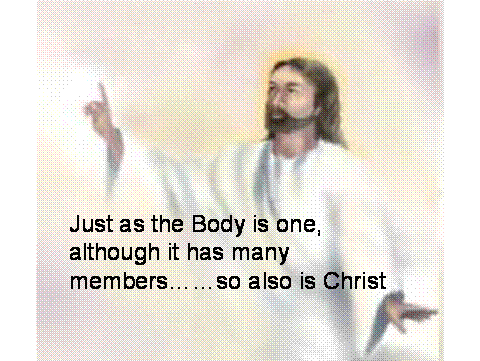
Paul likens the Church to the Body of Christ. He says, clip_image002

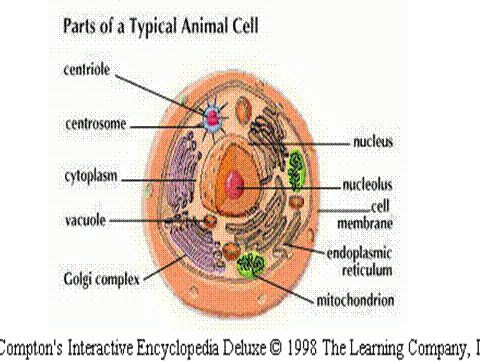
Now anybody who has ever done any Biology will know that our body is made up of cells. Perhaps you’ve had to learn to draw a diagram of a typical animal cell and it looks like this… clip_image004

Every cell in your body has the same DNA, bundled into 23 pairs of Chromosomes. clip_image006

That is what makes you, you and me, me.

Now every part of Christ’s body has His Holy Spirit. If we have asked Jesus to come into our lives and take over ownership, we have the Holy Spirit living in us. That is our spiritual DNA.

But guess what? If we look carefully at the cells of our body, we don’t even see one that resembles the typical animal cell we just talked about.

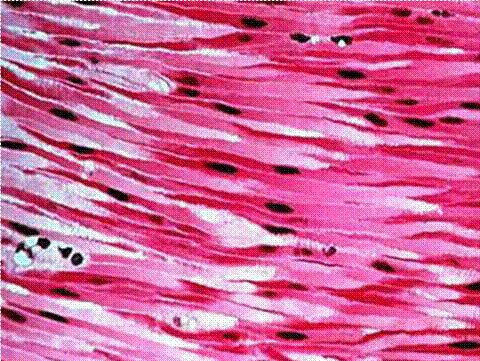
Let’s look at muscle cells. clip_image008

Kind of long and skinny, aren’t they. These cells are very active and use a lot of energy. They get things done. There are people in the church like this and let’s face it, the church would not function without them. They are always busy – feeding the hungry, raising money for the poor, educating the illiterate. If Martha was a body cell, she would probably have been a muscle cell. Other cells might say they are not spiritual enough. But even muscle cells need to be fed. They need a time to rest as well as a time to work. Otherwise the body would not function properly.

Then we have bone. clip_image010

Bone gives structure and order to the body. Christians who have studied the bible extensively and have done a lot of reading are a bit like bone cells. They usually have an accumulated life experience as well and have walked with the Lord a long time. They are wise. They know the rules and stick by the rule book.

Other cells might say they are too rigid and set in their ways. The biggest danger to bone cells is if they lose their connection to the Lord. If routine and discipline and order strangle out the voice of the Spirit and they just keep going in the same path without the life of Christ, the bones might get brittle and break too easily.

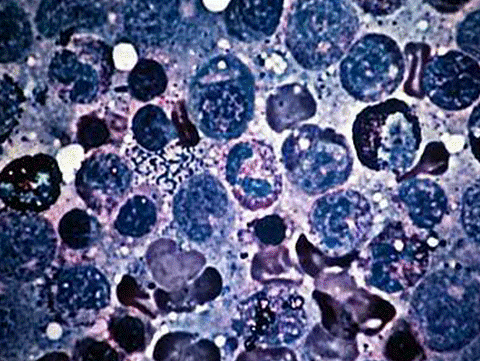
Still with bone, we have bone marrow. This is where new blood cells are made. clip_image012

These people are the evangelists. They are so excited when people come to the Lord.

They are essential for the life and the ongoing existence of the body. Billy Graham might be an example of a bone marrow Christian. It is the job of all cells to reproduce- to make new cells to replace old ones but bone marrow does it as its primary function. Other cells might say they are not practical. They are so busy thinking about people’s souls, they forget their bodies, their need for support and sometimes the new converts are left to flounder on their own. The danger for bone marrow Christians is when they start judging success by the world’s standards. How many people came to the rail or signed commitment forms. They forget whose work it is. Only God can make a person a Christian.

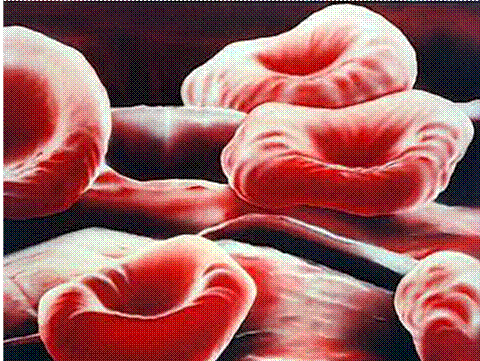
Then we have the pray-ers, the red blood cells, clip_image014

supplying oxygen and life for every cell in the body,

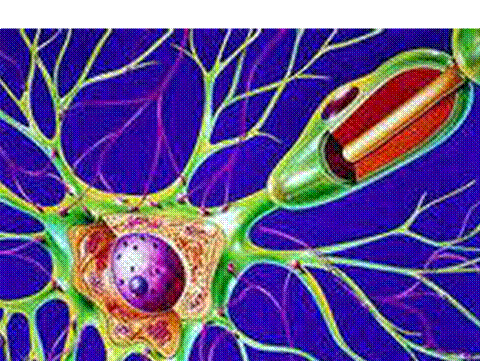
the nerve cells, clip_image016

the communication network ,

macrophages, clip_image018

who guard the body from infection and distortion,

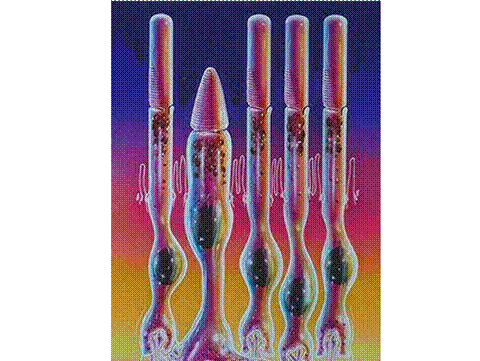
and my favourite picture, the cells in the eye. clip_image020

These are rods and cones, the cells that make up the retina of the eye. They have different functions. The rods see light and dark, the cones see more detail. These are the people who see the vision. But unless they communicate with the nervous system, the vision is lost. Some cells might say they don’t do anything so they are useless.

There are many more. I could spend 100 pages showing you pictures of body cells but this is a sermon, not Biology class.

The point is, just as there is no typical animal cell, there is no typical Christian. We are all different and that is not a mistake, God did it on purpose. We are all unique and God made us with a purpose, with a plan in mind.

Of course we think that all Christians should be exactly like us, should think like us, should worship like us.

Because we are all different, God deals with us differently. Nobody can say to another Christian, because your experience is not my experience, you are not a Christian.

Paul says, “For we are all baptised by one Spirit into one body- whether Jews or Greeks, slave or free- and we were all given the one Spirit to drink.” We can make this more relevant to our situation by saying “We are all baptised by one Spirit into one Body, whether Youth or Old Fogy, Black or White, Educated or Uneducated- and we were all given the one Spirit to drink.”

He goes on to say, imagine of one part of the body felt inferior to the rest of the body.

Imagine if a bone cell were to say, because I am not a muscle cell, I am useless, or if a nerve cell were to say, because I am not a rod or a cone, I am not part of the body. We can all see that that is ridiculous. We would hate any such thing going on in our body.

And Christ hates such things going on in His body.

Jesus prays for His disciples in John 17:20-21. “I pray also for those who will believe in me through their message, that all of them may be one, Father, just as you are in me and I am in you. May they also be in us, that the world may believe that you have sent me.”

In 2000 years, Jesus’ prayer has not been answered. His disciples are not one. Being one, does not mean being the same. God made us individual and unique, he does not want “typical Christian clones.” But what he does want, is unity. He does not want Christians refusing to accept each other, criticising each other because of their God made differences.

Paul says in verse 18, “God has arranged the parts of the body, every one of them, just as He wanted them to be.”

God has put us where we are. He has put us with the people He has ordained. It is not for a toe cell to decide – I don’t want to be part of the foot – I am surrounded by calloused cells. I want to be part of the hand. That is where the action is. I’ll just move.

One part of the body, can’t say to another, “I don’t need you.” When that happens in our body and one part starts attacking another, it is an autoimmune disease and we die from it.

Vs 24 “ But God has combined the members of the body and given greater honour to those that lacked it, so there should be no division in the body, but that its parts should have equal concern for each other. If one part suffers, every part suffers with it, if one part is honoured, every part rejoices with it.”

When we first look at a body what hits us is skin. The skin is the largest organ of the body and statisticians would probably find out that there are more skin cells in the body than any other kind. So it would be easy for, say the adrenal gland to think I am not a skin cell, therefore I don’t fit in. Those who think they don’t fit in are all the more important because they have their uniqueness to offer. “God has given greater honour to those who lacked it”

What can we do practically, to accept other people, particularly those in Christ’s body?

First of all, Jesus accepted everyone. Here he was, the sinless son of God, and they brought Him a woman caught in adultery. As a good Jewish boy he knew very well that adultery was a sin forbidden in the law of Moses. Notice he did not condone her sin. He said, I do not condemn you, go and sin no more. He accepted her. He treated her with respect.

The Samaritan woman, a hated foreigner, he treated as a person of worth. South Africa’s equivalent today would probably be a Nigerian – after all many people think they are all criminals. We make jokes about them. But Jesus never treated anyone other than with respect and acceptance.

Paul says in Phil 2:5 “let this attitude be in you that was also in Christ Jesus.”

Let us treat others with the attitude of Jesus.

That includes the teacher at school who has it in for you, it includes the inefficient black woman at work who has been promoted over you because of affirmative action, It includes the loud, noisy neighbours who’s teenage son has just bought an ear splitting new car sound system.

As our section of the body, the Randmeth Church, I would suggest the following four steps.

  1. Find out what your gift is, your purpose and use it to God’s glory and the building up of our church. Everybody has something to offer. But remember – Christ is the head. It is His Body and He is in control.
  1. Don’t be oversensitive. I’m sorry to be the one who has to break it to you, but the world does not revolve around you. People are probably not talking about you when you come to a little group in discussion, they have much more important things to talk about, themselves for instance. If your name does not appear in the church notices, it is not because the office staff are out to get you.

If you are not invited to present your team’s report at some boring meeting, it is not because your team is unimportant.

Oversensitivity is a subtle form of selfishness. It is relating everything in the world to you and how it affects you. It is just as much a sin as the more overt form of selfishness.

Because sin has tarnished the image of God in all of us, you will sometimes get negative comments. Other people aren’t perfect either you know but just because one person in the church says you can’t buy two cakes at the cake sale does not mean that the whole church rejects you and you should now find another church. Just because one person criticises the work you have done for the Lord, does not mean that nobody values your work and you will never do anything for the Lord again. In fact it would be much safer if you just did everything for the Lord and not for people anyway. Christ is the head of the Church. He is the one in control. We should never confuse God’s work with our work. We are working for Christ according to His instructions, not what seems good to us.

  1. Put on rose coloured spectacles. I have said we are all imperfect and a mixture of good and not so good. It is easy to see the not so good. Let us make an effort to see the good in people, in their work and filter out the not so good.

Can we see God’s image in other people? It is there, you know. One of the Holiday club leaders told us last week that although they had gone to teach children, in some cases they had learned from Children. That is seeing God’s image in other people.

Don’t look at the differences that irritate you. Look at the things we have in common. We are all working for the good of one body.

  1. Let your words build up, not break down. Tomorrow, somebody will probably phone the church office to complain about tonight’s service. Perhaps they didn’t come for a Biology lesson, but an uplifting sermon. Perhaps they didn’t like the music. Let’s put on our rose coloured spectacles and filter out what we didn’t like and look for perhaps just one thing that we did like.

Compliment rather than criticising and complaining. When you feel a negative comment coming, zip your lip. Think hard to find a positive comment and then hand it to someone as a gift from God.

You know yourself how a simple thank you or a well done grows your spirit.

Shall we withhold life and growth to our fellow body cells?

And when you are given a compliment, sniff at it and then give it to the Lord. Any beauty you have is from Him. Any talent you have is from Him. Anything you have achieved is only because He has enabled you. Give Him the glory.

“Now you are the body of Christ, and each one of you is a part of it.”

clip_image022